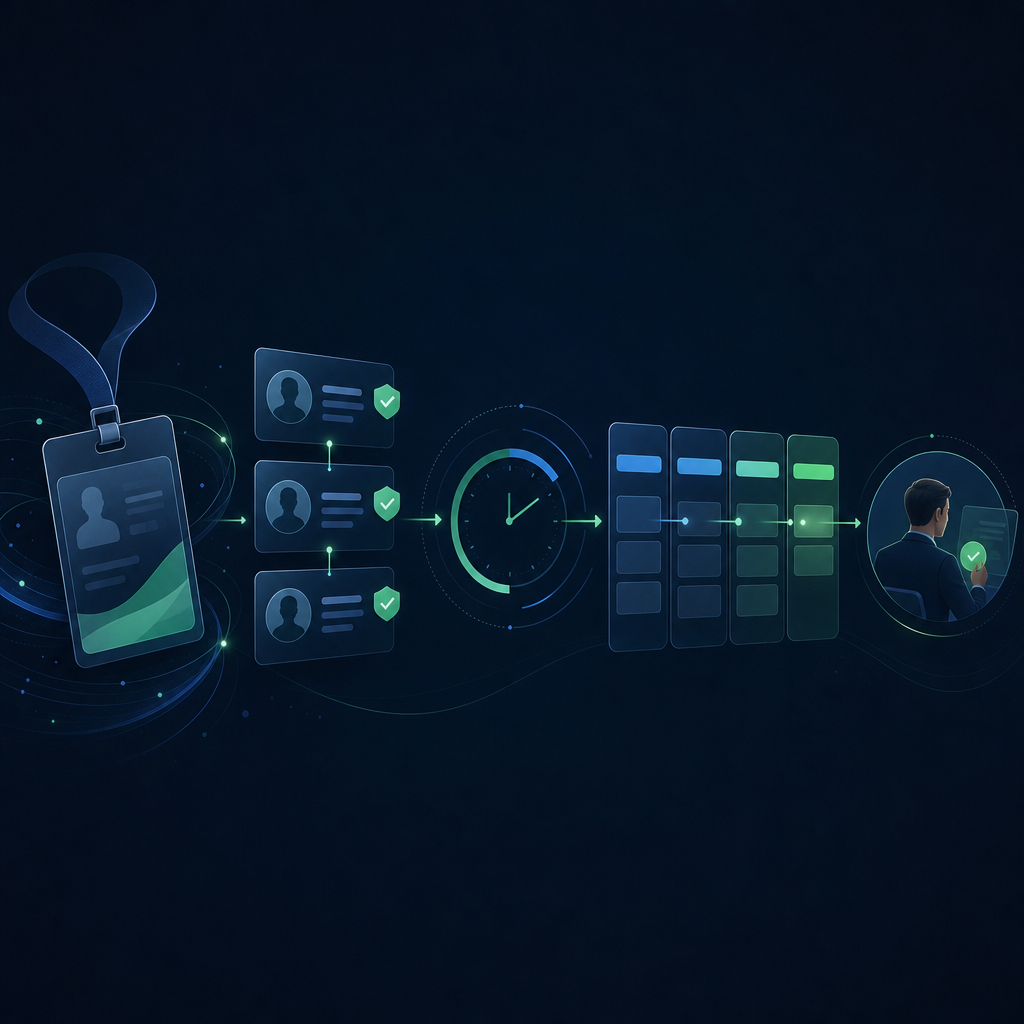
A post-conference follow-up workflow is the operating system that moves a real event conversation from notes to a verified contact, a relevant next step, and an accountable CRM record. The best workflow begins before the event, captures context during it, and prioritizes follow-up within 24 hours instead of sending the same generic message to every badge scan.
The Direct Answer
Use five stages: prepare, capture, verify, prioritize, and advance. Before the event, define account questions and CRM fields. During conversations, record the problem, timing, consent, and promised next step. Afterward, verify the person and role from current public or professional sources, score the record, assign an owner, and follow up with the specific item promised.
Why Most Conference Follow-Up Fails
The common failure is not a missing email sequence. It is missing context.
- Badge scans identify a person but rarely explain why a conversation mattered.
- Notes remain in phones, notebooks, and event apps instead of the CRM.
- Contacts change roles between list purchase and outreach.
- Every conversation receives the same “great meeting you” message.
- Sales cannot distinguish a live project from polite interest.
- Marketing reports scans while revenue leaders need qualified progression.
The result is a large event list with little evidence, weak ownership, and no defensible next action.
The Post-Conference Follow-Up Proof Stack
A useful record should carry seven layers of proof:
| Layer | Required evidence | Why it matters |
|---|---|---|
| Identity | Name plus current professional profile or company page | Prevents contacting the wrong person |
| Role | Current title, function, and seniority | Shows whether the buyer can influence the decision |
| Company fit | Industry, size, geography, and relevant operating model | Confirms ICP alignment |
| Conversation | Problem discussed and language the person used | Makes the message specific |
| Timing | Project window, trigger, or agreed follow-up date | Separates interest from urgency |
| Permission | Channel preference or requested resource | Keeps outreach relevant and defensible |
| Action | Owner, due date, and next CRM stage | Prevents useful conversations from stalling |
Do not treat an event directory or historical attendee list as proof that a person currently works at a company, attended a specific session, or wants unrelated outreach. Verify what you can and mark what remains unknown.
Before the Event: Design the Handoff
The workflow starts when the event plan is written, not when the booths close.
Define the account question
Replace “Who should we meet?” with a decision such as:
- Which attending companies are opening facilities in our service region?
- Which accounts announced a leadership, hiring, funding, or technology change?
- Which existing opportunities have multiple stakeholders at the event?
- Which public speakers represent a business problem we can credibly solve?
Create required CRM fields
At minimum, capture:
- Source URL and observed date
- Event and conversation date
- Current role and company
- Business problem discussed
- Evidence or trigger
- Promised resource or next step
- Confidence level
- Owner and due date
Prepare useful follow-up assets
Match assets to likely conversations: a concise case study, buyer checklist, technical explainer, pricing guide, or meeting brief. Do not build a generic attachment library and expect the seller to choose later.
During the Event: Capture Meaning, Not Transcripts
Write notes for the next person who must act. A strong note answers:
- What changed at this account?
- Why did the person care?
- What did we promise?
- Who else is involved?
- When should we reconnect?
- What should we avoid claiming?
Ask permission before recording or quoting people. Do not publish private meeting details, personal contact data, or statements that were not given for attribution.
For a broader research method, use the guide to conference attendee research without buying bad lists.
After the Event: The 24-Hour Triage
Run a single review while memory is fresh.
Priority A: act today
These records include a specific problem, current role, clear fit, and agreed next step. Send the promised item and suggest one bounded action.
Priority B: verify before outreach
These conversations appear relevant but have an uncertain role, unclear timing, or missing account evidence. Research first. Do not fill gaps with assumptions.
Priority C: nurture or close
These records are useful for a future topic, partner relationship, or content audience but do not support a sales action now. Route them appropriately instead of forcing them into pipeline.
Priority D: suppress
Remove duplicates, personal addresses, unverifiable contacts, explicit opt-outs, competitors with no partnership reason, and records collected without a lawful or relevant use.
A Five-Touch Sequence That Preserves Context
The cadence should follow the buyer’s request, not a rigid automation rule.
| Timing | Purpose | Example |
|---|---|---|
| Within 24 hours | Deliver the promise | “You asked for the role-verification checklist; here it is.” |
| Day 2–3 | Clarify the decision | Ask one question tied to the stated problem |
| Day 5–7 | Add evidence | Share a relevant case, benchmark, or technical answer |
| Day 10–14 | Offer a bounded next step | Suggest a short review with a defined agenda |
| Day 21+ | Close the loop | Ask whether to revisit later or stop |
Do not pretend a sequence creates intent. Engagement is useful only when connected to the original conversation and a current business question.
CRM Handoff Example
Weak record: “Met Jamie at conference. Interested. Follow up.”
Useful record: “Jamie Chen, VP Network Operations at ExampleCo; role verified on company leadership page September 9. Discussed new-market fiber expansion and difficulty identifying local property partners. Requested a two-page account-research checklist. Send by September 10. If useful, propose a 20-minute territory review. Confidence: medium because project timing was not confirmed.”
The second record lets another seller act without inventing context.
Metrics That Show Whether the Event Created Pipeline
Track the workflow as a funnel:
- Relevant conversations
- Complete context records
- Roles verified
- Promised follow-ups delivered on time
- Replies tied to the event conversation
- Qualified meetings completed
- Opportunities created or advanced
- Pipeline and revenue under the company’s attribution rule
- Suppression, bounce, and duplicate rates
Cost per badge scan rewards volume. Cost per completed relevant meeting and cost per qualified opportunity reveal whether the process worked.
Compliance and Data Boundaries
Conference contact data is still personal data. Follow applicable privacy, electronic-marketing, and event-platform rules. Keep source, purpose, retention, suppression, and access controls documented. Public availability does not automatically permit every use.
For U.S. commercial email, review the FTC CAN-SPAM compliance guide. For UK electronic marketing, consult the ICO guidance on direct marketing using electronic mail.
Editorial Decision Q&A
What matters more: speed or verification?
Both, but not in the same step. Deliver a promised resource quickly, then verify uncertain identity and role fields before broader outreach or CRM automation.
Should every event contact enter a sequence?
No. Route only contacts with a relevant purpose, sufficient evidence, and an appropriate outreach basis. Nurture, partner, press, and sales records may require different owners.
Can an event app be exported into a prospect database?
Do not assume so. Follow the event’s terms, the app’s rules, applicable law, and the expectations attached to the directory.
Frequently Asked Questions
When should post-conference follow-up begin?
Deliver a promised item within 24 hours when practical. Run identity, role, context, and ownership triage at the same time so fast follow-up does not become inaccurate follow-up.
Who gets the most value from a post-conference follow-up workflow?
Sales, marketing, partnerships, RevOps, and founders benefit when an event produces many conversations but the organization struggles to preserve context and assign next actions.
What should a team prepare before a conference?
Prepare account questions, required CRM fields, note-taking guidance, follow-up assets, ownership rules, and a suppression process. This makes the post-event handoff much faster.
How should meetings, content, and follow-up connect after an event?
The meeting should identify the buyer question, the content should answer or support that question, and the follow-up should deliver the promised asset with one relevant next step.
What metrics show whether conference activity created qualified pipeline?
Track complete records, verified roles, on-time follow-ups, qualified meetings, opportunity progression, pipeline, revenue, and data-quality failures under a documented attribution window.
How long should conference leads remain active?
Use the buyer’s timing and your retention policy. Close or nurture records that lack current evidence rather than leaving them indefinitely in an active sales queue.
Next Steps
Run the proof-stack review before your next event export. If the records still lack current roles, source evidence, confidence, or a human-owned action, use Lead Seeker’s prospect intelligence platform to build a smaller, verifiable follow-up set.
Sources
- Harvard Business Review, How to Follow Up With People After a Conference
- Federal Trade Commission, CAN-SPAM Act: A Compliance Guide for Business
- UK Information Commissioner’s Office, Guidance on direct marketing using electronic mail